|
Current Research
The
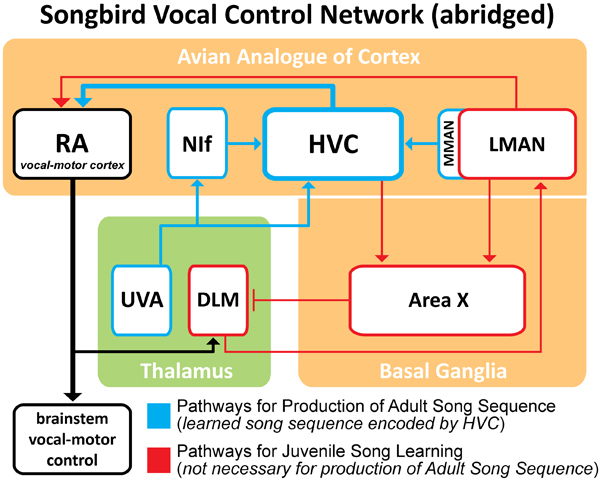
zebra finch CNS is ideally suited
for the study of brain/behavior relationships. For example, the image
below shows how the structure of the song region RA changes as a function of learning to sing.
RA initially develops in
juveniles of both sexes and shows additional growth during the period of song
learning in males. In contrast, female RA undergoes an extensive
loss of neurons. Related patterns of development are seen in other
song regions. Our research
seeks to identify the underlying cellular and molecular processes that
account for these dramatic differences in neural and behavioral
development. In doing so, we hope to discover basic principles that will lead to a greater understanding of human brain
development and learning. Research topics in the lab are
summarized below.

1.
Neurotrophins
 |
Neurotrophins are cell-cell signaling molecules
that regulate neuron survival and differentiation in a variety of vertebrate
species, including humans. We
are investigating the role of a neurotrophin (BDNF)
in song system development. At right is an HVC neuron from a male zebra finch, labeled with a
BDNF antibody. The release of neurotrophins may influence
the growth of song regions in juvenile males. |
2. Endogenous
Cannabinoids
Cannabinoids are the class of drugs found in
marijuana, which have their effects by interfering with endogenous
cannabinoid signaling in the brain. The role of endogenous cannabinoids is not
well understood but may be related to voluntary motor function, learning, and
memory. We have found that mRNA encoding cannabinoid
receptors (CB1) is highly expressed in HVC and RA and that
cannabinoids dose-dependently reduce the amount that adult birds sing. We are now
investigating how cannabinoids affect the ability of juvenile birds to learn to
sing and the development of song regions. Shown above is a northern blot of various zebra finch tissues, showing high levels of CB1 mRNA
in brain.
3.
Behavior-Driven Gene Expression
It
is traditional to think that genes determine behavior, and of course to a
degree this is true. However, behavior and sensory experience can
also influence gene expression. Shown above are two images of RA showing that
expression of the ZENK gene in RA neurons is driven by singing. ZENK
is a songbird homologue of a human transcription factor gene called egr-1.
As
a transcription factor, ZENK regulates the expression of
other genes. Why should behavior activate gene expression? We
are working to determine the functional consequences of singing-driven
ZENK expression, focusing on the possibility that ZENK expression may be
involved in storing the effects of vocal practice.
4.
Does (Vocal) Practice Make Perfect?
Do birds
that sing more during vocal development learn faster or better than birds
that sing less? Similarly, do increased levels of singing lead to
the development of larger brain regions for song? Because singing is
a voluntary behavior, it can be difficult to quantify. Therefore, we
are using computerized recording techniques and methods to measure
vocal production in real time during the period of song learning. A
role for use-dependent mechanisms has ample precedent in other forms of
motor learning and neural growth and plasticity, but our studies are
some of the first to examine vocal learning in this
context.
return
to top of page
|